- This topic is empty.
-
AuthorPosts
-
2025-11-02 at 5:28 pm #3497
Do Kyong Kim
KeymasterKeynote Speech III – Vietnam Representative (UNIDO Vietnam Office)
Speaker: Ms. Hoang Mai Van Anh
Position: National Programme Coordinator, UNIDO Vietnam Office
Title: “Vietnam’s Agri-Food Industry Trends and UNIDO’s National Programme”
🌾 1. Introduction
Ms. Hoang Mai Van Anh opened her presentation by emphasizing the strong partnership between Vietnam and Korea in the fields of agriculture, food processing, and sustainable rural development.
Korea remains one of Vietnam’s leading investors, particularly in high-tech agriculture, smart farming, and agri-food innovation.The objective of her keynote was to highlight Vietnam’s current agri-food industry trends and UNIDO’s ongoing initiatives that aim to promote green growth, innovation, and circular economy practices in Vietnam’s agricultural and food sectors.
📈 2. Vietnam’s Agri-Food Industry – Key Trends
▪ Current Situation
-
In 2024, Vietnam’s agriculture–forestry–fishery exports reached USD 62.4–62.5 billion, representing an 18.5% increase over 2023.
The target for 2025 is USD 64–65 billion. -
Key export products: fruits & vegetables (USD 7.1 billion), seafood, wood, and coffee.
-
The food processing industry grew by 7–14%, reaching an estimated USD 79 billion.
-
Standards and Traceability: Efforts are being made to comply with international quality and safety standards (HACCP, GlobalG.A.P., EU/US traceability systems).
-
Post-harvest losses remain high due to limited cold storage and logistics capacity.
-
Cold-chain logistics has become one of the fastest-growing investment sectors, especially in southern Vietnam, with the government encouraging Public–Private Partnerships (PPPs) in agri-logistics and cold storage infrastructure.
▪ Challenges and Risks
-
High input cost volatility (fertilizer, feed, energy).
-
Climate change impacts: droughts, salinity intrusion, floods.
-
Increasing demands for certification, standards, and origin traceability in global markets.
-
Fragmented supply chains and limited technological modernization.
▪ Opportunities and Future Directions
-
Enhance Vietnam’s agri-food branding and global market recognition.
-
Promote circular economy models and low-carbon agri-food systems.
-
Strengthen SMEs and cooperatives to meet international quality standards.
-
Accelerate technology transfer in AI, IoT, drones, and precision farming.
-
Improve export-oriented and domestic value chains, ensuring food safety and traceability.
🌱 3. Transformation of Vietnam’s Agriculture Sector
UNIDO outlined three major structural shifts shaping Vietnam’s agricultural transformation:
-
From “agricultural production” to “agricultural economy”
→ Shifting focus from quantity and productivity to economic value and market-based growth. -
From “single-sector development” to “multi-sector integration”
→ Linking agriculture with industry, services, and digital technologies to create a multi-value ecosystem. -
From “high-yield agriculture” to “high-tech, ecological, responsible, and sustainable agriculture”
→ Promoting technology-driven, environmentally responsible, and climate-smart agricultural systems.
⚙️ 4. UNIDO’s Focus Areas Related to Agro-Industry
UNIDO’s work in Vietnam’s agro-industrial development focuses on six strategic areas:
-
Innovation and Digitalization
-
Sustainable Investment and Technology Promotion
-
Quality Infrastructure and Smart Production
-
Modernizing Agro-Industries and Skills Development
-
Sustainable Food Systems
-
Rural Entrepreneurship, Job Creation, and Human Security
🔥 5. Example of UNIDO Project: Strengthening the Business Case for Small-Scale Pyrolysis in Vietnam
Project Title: Strengthen the Business Case of Small-Scale Pyrolysis in Vietnam
Partners: VNCPC, Sofies, HUSK, Ökozentrum, UIT, WIUT, Switzerland▪ Objectives
-
To improve resource productivity and environmental performance of enterprises.
-
To contribute to sustainable industrial development and responsible production and consumption.
▪ Focus
-
Developing waste recovery and valorization technologies for selected sub-sectors (e.g., coffee and rice).
-
Applying small-scale pyrolysis systems to transform agricultural by-products into biochar, a core material in climate-smart agriculture.
▪ Technology Model
-
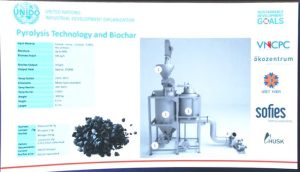
Input materials: coffee husks, cashew shells, rice husks.
-
Biomass input: 150 kg/hour.
-
Biochar output: 45 kg/hour.
-
Reactor temperature: 450–550°C.
-
Energy output: 75 kW.
-
Composition:
-
Carbon: 82%
-
Potassium: 11 mg/g
-
Nitrogen: 7 mg/g
-
pH: 9.0
-
-
Weight: 2.4 tons; Dimensions: 4 m × 2.4 m.
-
Technology origin: Sofies, Switzerland.
▪ Expected Impacts
-
Improvement of soil fertility and water retention.
-
Reduction of greenhouse gas emissions and carbon sequestration.
-
Economic valorization of agricultural waste for rural income generation.
-
Demonstration of a scalable circular economy model for smallholder farmers.
🎯 6. Objectives by 2030
Target Area Objective GDP Growth 2.5–3% annually Labor Productivity 5.5–6% annually Export Growth 5–6% annually Rural Income 2.5–3 times higher than in 2020 Poverty Reduction ≥1.5% annual decrease in multidimensional rural poverty Agricultural Labor Share Below 20% of total labor force Trained Agricultural Workers Over 70% trained workforce GHG Emission Reduction 10% reduction compared to 2020 Forest Coverage 42%; over 1 million ha certified for sustainable forest management New Rural Development 90% of communes meet rural standards; 50% achieve advanced standards
🌐 7. Conclusion
Ms. Hoang Mai Van Anh concluded her presentation by emphasizing that international cooperation and technological innovation are key to realizing Vietnam’s agricultural transformation.
“Vietnam is moving from a production-oriented model toward an agricultural economy that integrates technology, sustainability, and inclusiveness. With UNIDO’s support, Vietnam is well on its way to becoming a regional hub for green and smart agriculture in ASEAN.”
She reaffirmed that UNIDO will continue to facilitate partnerships, technology transfer, and policy dialogue to help Vietnam achieve its 2030 goals for green growth, climate resilience, and rural prosperity.
Keynote Speech III – Vietnam Representative (UNIDO Vietnam Office)
Speaker: Ms. Hoàng Mai Vân Anh
Position: National Programme Coordinator – UNIDO Vietnam Office
Title of Presentation: “Vietnam’s Agri-Food Industry Trends and UNIDO’s National Programme”
🌾 1. Introduction
Bà Hoàng Mai Vân Anh mở đầu bằng việc nhấn mạnh mối quan hệ hợp tác hiệu quả giữa Việt Nam và Hàn Quốc trong lĩnh vực nông nghiệp, công nghiệp chế biến thực phẩm, và phát triển nông thôn bền vững.
Việt Nam hiện là một trong những điểm đến đầu tư hàng đầu của Hàn Quốc, đặc biệt trong nông nghiệp công nghệ cao và chế biến thực phẩm xuất khẩu.
Mục tiêu của phần trình bày là giới thiệu xu hướng phát triển ngành nông nghiệp – thực phẩm của Việt Nam và các chương trình quốc gia do UNIDO hỗ trợ nhằm hướng tới tăng trưởng xanh, đổi mới sáng tạo và phát triển tuần hoàn.
📈 2. Xu hướng ngành nông nghiệp – thực phẩm Việt Nam (Vietnam Agrifood Industry – Key Trends)
Tình hình chung (Situation):
-
Năm 2024, xuất khẩu nông – lâm – thủy sản của Việt Nam đạt 62,4–62,5 tỷ USD, tăng 18,5% so với năm 2023; mục tiêu năm 2025 đạt 64–65 tỷ USD.
-
Sản phẩm xuất khẩu chủ lực: Trái cây & rau củ (7,1 tỷ USD), thủy sản, gỗ và cà phê.
-
Ngành chế biến thực phẩm: Tăng trưởng 7–14%, đạt gần 79 tỷ USD.
-
Tiêu chuẩn & truy xuất nguồn gốc: Tập trung đáp ứng các tiêu chuẩn quốc tế (HACCP, GlobalGAP, EU/US traceability) để thâm nhập thị trường cao cấp.
-
Thất thoát sau thu hoạch: Vẫn cao do hạn chế kho lạnh và phương tiện vận chuyển.
-
Chuỗi lạnh (Cold chain): Đang trở thành lĩnh vực đầu tư phát triển nhanh nhất, đặc biệt tại miền Nam.
Chính phủ khuyến khích hợp tác PPP (Public–Private Partnerships) trong logistics và chuỗi lạnh.
Thách thức và rủi ro (Challenges & Risks):
-
Biến động chi phí đầu vào (phân bón, năng lượng, thức ăn chăn nuôi).
-
Ảnh hưởng của biến đổi khí hậu: hạn hán, bão lũ, xâm nhập mặn.
-
Yêu cầu cao hơn về tiêu chuẩn, truy xuất nguồn gốc, và chứng nhận quốc tế.
-
Cạnh tranh thị trường và rào cản thương mại ngày càng gia tăng.
Cơ hội và định hướng tương lai (Opportunities & Future Directions):
-
Tăng giá trị thương hiệu nông sản Việt Nam trên thị trường toàn cầu.
-
Đầu tư vào kinh tế tuần hoàn và hệ thống nông nghiệp carbon thấp.
-
Hỗ trợ doanh nghiệp nhỏ và hợp tác xã đạt chuẩn quốc tế về chất lượng.
-
Thúc đẩy chuyển giao công nghệ tiên tiến: AI, IoT, drone, canh tác chính xác.
-
Củng cố chuỗi giá trị trong nước và xuất khẩu, tăng năng lực logistics và thương mại.
🌱 3. Định hướng phát triển nông nghiệp Việt Nam (Vietnam Agriculture Sector Transformation)
UNIDO trình bày ba định hướng chuyển đổi chính trong chiến lược phát triển nông nghiệp Việt Nam:
-
Từ “sản xuất nông nghiệp” sang “kinh tế nông nghiệp”
→ Chuyển trọng tâm từ sản lượng sang giá trị kinh tế và chuỗi giá trị thị trường. -
Từ “phát triển đơn ngành” sang “phát triển đa ngành, đa giá trị”
→ Liên kết nông nghiệp với công nghiệp, dịch vụ, du lịch, và công nghệ số. -
Từ “nông nghiệp năng suất cao” sang “nông nghiệp công nghệ cao, sinh thái và bền vững”
→ Ứng dụng công nghệ thông minh, thân thiện môi trường, hướng tới phát thải thấp.
⚙️ 4. Các lĩnh vực trọng tâm của UNIDO trong công nghiệp nông nghiệp (UNIDO’s Focus Areas Related to Agro-industry)
UNIDO tập trung hỗ trợ Việt Nam trong 6 lĩnh vực ưu tiên, gồm:
-
Innovation & Digitalization – Đổi mới sáng tạo và số hóa.
-
Sustainable Investment & Technology Promotion – Đầu tư và chuyển giao công nghệ bền vững.
-
Quality, Infrastructure & Smart Production – Hạ tầng chất lượng và sản xuất thông minh.
-
Modernizing Agro-Industries & Skills Development – Hiện đại hóa ngành công nghiệp nông nghiệp và nâng cao kỹ năng lao động.
-
Sustainable Food Systems – Xây dựng hệ thống thực phẩm bền vững.
-
Rural Entrepreneurship, Job Creation & Human Security – Thúc đẩy khởi nghiệp nông thôn, tạo việc làm và đảm bảo an sinh.
🔥 5. Dự án tiêu biểu của UNIDO tại Việt Nam
Project: Strengthen the Business Case of Small-Scale Pyrolysis in Vietnam
Đối tác: VNCPC, Sofies, HUSK, Ökozentrum, UIT, WIUT, Switzerland.Mục tiêu (Objectives):
-
Nâng cao hiệu suất sử dụng tài nguyên và hiệu quả môi trường của doanh nghiệp.
-
Thúc đẩy phát triển công nghiệp bền vững và tiêu dùng có trách nhiệm.
Trọng tâm (Focus):
-
Phục hồi và tái sử dụng chất thải nông nghiệp theo hướng giá trị hóa phụ phẩm (cà phê, gạo).
-
Ứng dụng công nghệ nhiệt phân (pyrolysis) quy mô nhỏ để sản xuất biochar.
Công nghệ chuyển giao (Technology Model):
-
Pyrolysis and Biochar – Công nghệ nông nghiệp khí hậu thông minh (climate-smart).
-
Sản phẩm biochar có thể dùng cho:
-
Cải thiện đất, giảm phát thải carbon,
-
Sản xuất năng lượng tái tạo,
-
Làm phụ gia thức ăn và vật liệu sinh học.
-
Chỉ số kỹ thuật (theo slide “Pyrolysis Technology and Biochar”):
-
Nguyên liệu đầu vào: vỏ cà phê, vỏ điều, trấu.
-
Công suất đầu vào: 150 kg/giờ.
-
Sản lượng biochar: 45 kg/giờ.
-
Nhiệt độ lò phản ứng: 450–550°C.
-
Hiệu suất năng lượng: 75 kW.
-
Thành phần sản phẩm:
-
Carbon: 82%,
-
Potassium: 11 mg/g,
-
Nitrogen: 7 mg/g,
-
pH: 9.0,
-
Khối lượng: 2,4 tấn,
-
Kích thước: 4 m x 2,4 m.
-
-
Nhà sản xuất: Công nghệ gốc từ Thụy Sĩ (Sofies).
🎯 6. Mục tiêu đến năm 2030 (Objectives by 2030)
-
Tăng trưởng GDP: 2,5–3%/năm; năng suất lao động: 5,5–6%/năm.
-
Giá trị xuất khẩu: tăng 5–6%/năm.
-
Thu nhập người dân nông thôn: tăng 2,5–3 lần so với 2020; giảm tỷ lệ nghèo đa chiều ≥1,5%/năm.
-
Lao động nông nghiệp: giảm dưới 20%; lao động được đào tạo: trên 70%.
-
Giảm phát thải khí nhà kính (GHG): giảm 10% so với 2020.
-
Diện tích rừng: đạt 42%; diện tích rừng có chứng nhận quản lý bền vững >1 triệu ha.
-
90% xã nông thôn đạt chuẩn nông thôn mới, trong đó 50% đạt chuẩn nâng cao.
🌐 7. Kết luận
Bà Hoàng Mai Vân Anh kết thúc bài trình bày bằng việc nhấn mạnh vai trò của hợp tác quốc tế trong đổi mới công nghệ và chuyển đổi nông nghiệp bền vững.
Thông qua sự hỗ trợ của UNIDO, Việt Nam đang tiến gần hơn tới mục tiêu trở thành trung tâm nông nghiệp công nghệ cao và kinh tế xanh của khu vực ASEAN.“Nông nghiệp Việt Nam đang chuyển mình mạnh mẽ – từ sản xuất sang kinh tế, từ số lượng sang giá trị, từ tăng trưởng sang phát triển bền vững.”
2025 세계 농업식품기술포럼 (World Agri-FoodTech Forum 2025)
주제 발표 III – 베트남 대표 (UNIDO 베트남 사무소)
발표자: 호앙 마이 반 안 (Ms. Hoang Mai Van Anh)
직책: UNIDO 베트남 사무소 국가 프로그램 코디네이터
발표 주제: “베트남 농식품 산업의 동향과 UNIDO의 국가 프로그램”
🌾 1. 서론
호앙 마이 반 안 코디네이터는 발표 서두에서
베트남과 한국 간의 농업 및 제조업 분야 협력관계가 매우 긴밀하고 발전적임을 강조했다.
특히 한국은 베트남의 주요 투자국 중 하나로,
농업기술·식품가공·스마트팜 등에서 다양한 성공 사례를 만들어가고 있다.이번 발표의 목적은 베트남 농식품 산업의 발전 현황과 주요 동향,
그리고 UNIDO가 추진 중인 지속가능한 농업 및 산업 프로그램을 소개하는 데 있다.
📈 2. 베트남 농식품 산업의 주요 동향 (Vietnam Agrifood Industry – Key Trends)
▪ 산업 현황 (Situation)
-
2024년 베트남의 농림수산식품 수출액은 624~625억 달러로,
2023년 대비 약 18.5% 증가,
2025년 목표치는 640~650억 달러로 설정됨. -
주요 수출 품목: 과일·채소(71억 달러), 수산물, 목재, 커피.
-
식품가공 산업: 2024년 기준 7~14% 성장, 총 산업 규모 약 790억 달러.
-
품질·표준·추적성(Traceability):
국제 기준(GlobalGAP, HACCP, EU/US 표준)에 부합하도록 체계적 관리 강화. -
수확 후 손실(Post-harvest loss):
저온 저장 및 운송 인프라 부족으로 여전히 높은 수준 유지. -
콜드체인(cold chain):
베트남 남부를 중심으로 급속한 성장세를 보이며,
정부는 민관협력(PPP) 방식의 투자 확대를 적극 장려 중.
▪ 도전과 리스크 (Challenges & Risks)
-
비료·사료·에너지 등 원자재 가격 변동성 심화.
-
기후변화 영향: 가뭄, 홍수, 염수 침입 등 지속적인 피해 발생.
-
국제 무역장벽: 품질인증·원산지 추적성 요구 강화.
-
농업 인프라 및 유통 체계 미비, 고비용 구조 지속.
▪ 기회와 향후 방향 (Opportunities & Future Directions)
-
국가 브랜드 가치 제고 및 고부가가치 수출 확대.
-
순환경제 및 저탄소 농식품 시스템 구축.
-
중소기업·협동조합의 품질인증 역량 강화.
-
첨단 기술 도입: AI, IoT, 드론, 정밀농업(Precision Farming).
-
국내 유통망 강화 및 수출형 가치사슬 확대.
🌱 3. 베트남 농업 부문의 구조 전환 (Vietnam Agriculture Sector Transformation)
UNIDO는 베트남 농업의 패러다임 전환 방향을 다음 세 가지로 요약하였다.
-
‘농업생산 중심’에서 ‘농업경제 중심’으로 전환
→ 생산량 확대보다 부가가치 창출과 시장경제적 접근을 강화. -
‘단일 산업’에서 ‘다부문 융합 산업’으로 전환
→ 농업·산업·서비스·디지털 기술이 통합된 복합 생태계 구축. -
‘다수확 농업’에서 ‘친환경·첨단·책임 있는 지속가능 농업’으로 전환
→ 기술기반 고품질 농업 및 저탄소 생산체계 구축.
⚙️ 4. UNIDO의 농식품 산업 관련 중점 분야 (Focus Areas Related to Agro-industry)
UNIDO는 베트남의 농식품 산업 발전을 위해 다음 여섯 가지 분야를 중점 추진하고 있다.
-
혁신과 디지털화 (Innovation & Digitalization)
-
지속가능한 투자 및 기술 촉진 (Sustainable Investment & Technology Promotion)
-
품질 인프라 및 스마트 생산 (Quality Infrastructure & Smart Production)
-
농산업 현대화 및 인적역량 개발 (Modernizing Agro-industries & Skills Development)
-
지속가능한 식품 시스템 구축 (Sustainable Food Systems)
-
농촌 창업·일자리 창출 및 인간안보 강화 (Rural Entrepreneurship, Job Creation & Human Security)
🔥 5. UNIDO 베트남의 대표 프로젝트: 소규모 열분해(Pyrolysis) 사업 모델 강화
프로젝트명: Strengthen the Business Case of Small-Scale Pyrolysis in Vietnam
협력기관: VNCPC, Sofies, HUSK, Ökozentrum, UIT, WIUT, Switzerland▪ 목적 (Objectives)
-
기업의 자원 효율성과 환경 성과를 향상시켜
지속가능한 산업발전과 책임 있는 소비를 촉진.
▪ 주요 내용 (Focus)
-
농업폐기물의 재활용 및 고부가가치화(Value Recovery) 기술 적용.
-
커피 껍질, 쌀껍질 등 부산물을 활용한 소규모 열분해(Pyrolysis) 시스템 운영.
-
생산품: 바이오차(Biochar) – 기후 스마트 농업(Climate-Smart Agriculture)의 핵심 소재.
▪ 기술 모델 (Technology Model)
-
Pyrolysis & Biochar System
-
투입 원료: 커피 껍질, 캐슈 껍질, 왕겨 등.
-
투입량: 150kg/h
-
바이오차 생산량: 45kg/h
-
반응 온도: 450~550°C
-
에너지 출력: 75kW
-
주요 성분:
-
탄소 함량 82%,
-
칼륨 11mg/g, 질소 7mg/g, pH 9.0
-
-
장비 무게: 2.4톤, 크기 4m x 2.4m
-
기술출처: 스위스 Sofies社
-
▪ 기대효과
-
토양 비옥도 개선 및 탄소저감 효과.
-
농가 소득 증대 및 농산 부산물의 경제적 활용.
-
지속가능한 농업기반의 산업화 모델 확산.
🎯 6. 2030년까지의 주요 목표 (Objectives by 2030)
항목 목표 내용 GDP 성장률 연 2.5~3% 노동생산성 연 5.5~6% 수출 증가율 연 5~6% 농촌 주민 소득 2020년 대비 2.5~3배 증가 빈곤 감소율 연 1.5% 이상 감소 농업 종사 비율 전체 인구의 20% 이하로 축소 농업 노동자 숙련도 70% 이상 직업교육 이수 온실가스 감축 2020년 대비 10% 감축 산림율 및 인증면적 산림율 42%, 지속가능 관리 인증면적 100만ha 이상 농촌 지역 개발 90% 이상 ‘신농촌 기준’ 충족, 그중 50%는 고도화 마을
🌐 7. 결론
호앙 마이 반 안 코디네이터는 발표를 마무리하며 다음과 같이 강조하였다.
“베트남은 단순한 농산물 생산국에서 벗어나,
기술·산업·환경이 결합된 지속가능한 농업경제 국가로 도약하고 있습니다.”UNIDO의 기술 지원과 국제 협력을 통해
베트남은 향후 아세안 지역의 농업기술·식품산업 혁신 허브로 성장할 잠재력을 가지고 있으며,
2030년까지 녹색·스마트·포용적 농업 발전을 실현하는 것을 목표로 하고 있다.
Attachments:
You must be logged in to view attached files. -
-
AuthorPosts
- You must be logged in to reply to this topic.